
Continuous On-Line Detection of Mercury in Water and Aqueous Solutions
The mercury process analyzer PA-2 is used for continuous monitoring of mercury concentrations in industrial processes. Applications include effluent and quality control in chlorine-alkali plants, monitoring of scrubber water of waste incinerators and power plants, control of industrial sewage and purification plants, quality control of sulphuric acid, drinking water. Special version also for concentrated caustic solutions (NaOH, KOH)
The PA-2 is not a laboratory analyzer simply converted for process applications but has been designed specifically for operation under harsh industrial conditions. The number of parts subject to wear has been minimized and particularly durable components have been chosen for use in critical locations. This results in extended maintenance intervals. The stripping unit is based on an aerosol-free principle and the need for cleaning the optical cell is particularly low.
- Fully automated on-line mercury detection system
- Easy menu-driven operation
- Proven and reliable detection method: UV absorption
- Used for EPA Method 7470A / EPA 7471A and others
- Display of real-time signal reading
- Mercury Measuring ranges from 0.01 ppb to 100 ppm
- High flexibility of sample pretreatment procedure
- Perfect for complex sample compositions
- Low reagent consumption
- Corrosion-protected construction
- Automatic self diagnosis system for reliable operation
Additional Product Details
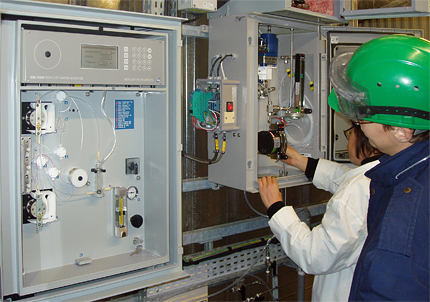
Flexibility in Sample Digestion
In practice mercury analysis sample matrices often show different and variable compositions. Depending on the chemical process the forms of mercury differ: elementary, ionic, dissolved as a salt, as an organic compound or as insoluble sulfide. The PA-2 offers a variety of sample pretreatment procedures to allow highly precise determination of total mercury in all these samples, with the results from the PA-2 showing very good correlations with standard laboratory analyses. High flexibility is achieved by the modular structure of the sample pretreatment module. This allows the user to choose from the following digestion methods:
- Sample pre-oxidation with hydrochloric acid + potassium permanganate
- Sample pre-oxidation with sulfuric acid + potassium permanganate
- Sample pre-oxidation with hydrochloric acid + sodiumchlorate
- Sample pre-oxidation with Fenton´s reagent
- The integrated heated reaction module allows accelerated sample digestion at increased temperatures. The duration of reactions can be adapted to the need of your application by employing reaction coils of different lengths.
Proven Mercury Measurement Principle
The detection of mercury contained in the sample occurs in an optical cell made of fused silica (Suprasil). In a first step mercury is reduced to the elementary state by means of tin(II)chloride or NaBH4. Subsequently mercury is stripped from the aqueous phase with an air stream and carried into the optical cell. Here the UV absorption measurement is conducted at a wavelength of 253,7 nm. This analytical technique called cold vapor atomic absorption spectroscopy (CVAAS) shows extreme sensitivity and selectivity. It has been reliable and proven for many years. In contrast to the occasionally recommended atomic fluorescence method the analytical technique utilized by the PA-2 is extremely low in interference and does not require an amalgamation step nor expensive noble gas as a carrier.
Industrial Grade Design
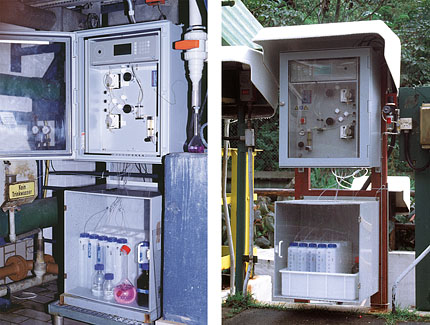
To provide optimum protection against corrosive environments all parts of the PA-2 Mercury Analyzer are enclosed in an industrial-grade cabinet made of fiber glass, reinforced polyester (protection class IP 66; NEMA 4X; etc.). The electronic circuitry is shielded from the wet chemical section by a chemically resistant wall.
Continuous and Interval Operation
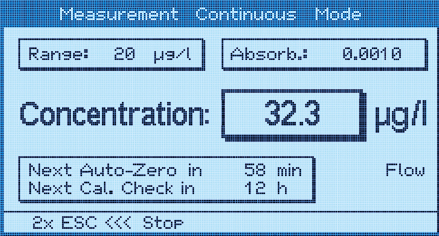
The PA-2 analyzer is controlled by a built-in computer and operates fully automatic. The continuous measuring mode can be switched over to a periodic measuring mode (for example 10 minutes of measurement every hour). Auto-Cal. Check: periodically the instrument switches from the sample stream to a calibration solution to check any deviation from the reference value. A status signal is generated if the value measured is out of range. Auto-Zero: the zero line of the analyzer is adjusted automatically after a preset period of time. Self-Cleaning: Precipitations like manganese dioxide are dissolved by an automatic rinse step which makes manual cleaning superfluous.
This online mercury analyzer is Easy to Operate
The PA-2 is operated via a waterproof membrane keypad. All inputs required are selected in a readily understandable menu shown on the graphical display. It is also possible to initiate some functions like Auto Zero from an external computer via the RS 232 interface.
Output and Display of Mercury Measurements
The analytical results are continuously displayed on an LCD in micrograms per liter and as absorption units. A linear electrical signal (4 ... 20 mA) is also output and can be connected to a recorder or to the analog input of a data acquisition system.
Automatic Self Diagnosis System
The PA-2 is equipped with sensors to detect malfunctions of the system and triggers an alarm for the operator. The following functions/malfunctions are checked and indicated:
- Reagent flow
- Sample flow
- Stripping air flow
- Leakage of fluids
- Photometer lamp
- Calibration
These features permit reliable unattended operation. Malfunctions are reported to the user both optically and via a status signal.
Communication with External Computers
The following data is available at the serial RS 232 interface: Actual mercury concentration Status (Ready - Maintenance - Malfunction) Thanks to the bidirectional interface, operational functions like "Zero Adjustment", "Calibration Check" and "Start Measurement" can be triggered externally
| Measuring principle | UV-Absorption |
|---|---|
| Wavelength | 254 nm |
| UV source | Electrodeless low-pressure mercury lamp |
| Stabilization method | Double beam (reference beam) method |
| Optical cell | Fused silica (Suprasil) |
| Optical cell heating | approx. 70°C |
| Measuring range | lowest range: 0...1 µg/Lhighest range: 0...100 mg/l |
| Response time (99% signal) | approx. 1 minute |
| Carrier gas | Air, approx. 30 L/h, 1 bar |
| Pump for liquids | Multichannel peristaltic pump |
| Reduction reagent | Tin-II-chloride or alternatively sodiumhydroborate |
| Reagent consumption | approx. 3 l / week for each reagent |
| Sample digestion | HCl or H2SO4, KMnO4 or H2O2 or Fenton´s Reagent or Na-chlorate (depending on sample composition) |
| Liquid-gas separation | Aerosol-free principle |
| Input device | Waterproof membrane keypad |
| Display of readings | Graphical LC display with background illumination |
| Output for concentration | 4...20 mA; RS 232 bidirectional |
| Output for status | Operational - Service - Malfunction, according to NAMUR 64 recommendations |
| Housing | Fibreglass-reinforced polyester, for use in highly corrosive environment - Reagent storage cabinet made of chemically resistant plastic material |
| Protection class | IP 66 (EN 60529/ NEMA 3; 3R; 4; 4X; 12; 13) |
| Power Supply | 230 V / 50 Hz (115 V / 60 Hz option) |
| Power consumption | 250 W max. |
| Air consumption | Instrument air, approx. 30 l / h,1 - 6 bar (14 - 85 psi) |
| Dimensions | 775 x 612 x 329 mm (WxHxD) |
| Weight | approx. 50 kg |
| ISO 9001 | As a leading supplier of high precision analytical equipment, we strive at all times to offer top quality solutions. Our products are manufactured according to the ISO 9001 quality regulations. |
Downloads

Download our digital brochure to learn more about about product details, safety information and other special features and benefits.
Download PDF BrochurePurchasing Information
Interested in purchasing or renting one of our products? Get started by requesting a quote. A member of our team will contact you directly with more information and next steps.
Request a Quote