
Fast determination of mercury in the laboratory
The LabAnalyzer 254 is a mercury vapor analyzer used for quantitative determination of mercury in aqueous samples and sample digests.
In contrast to a typical multi-element AAS the LabAnalyzer 254 is specially designed for elemental mercury. This allows top performance in analytical applications. The use of a specially developed highly stable mercury lamp in connection with thermostat-controlled UV sensors results in a detection limit of a few ppt of mercury. Memory effects are minimized and a high sample throughput is possible thanks to specially selected materials for sample gas conducting components and heating of the optical bench.
- No gases or fume hood required
- Fixed optical system not requiring any adjustment
- Sensitive detection method: UV absorption (CVAAS)
- Used for EPA Method 7470A / EPA 7471A and others
- Measuring range 0.01 ppb ... 10 ppb (10 ng/l to 10 µg/l)
- Hg trap: Mercury vapors cannot escape into the lab
- Small Foot Print
- Low reagent consumption
- Upgradable to be used as both LA-254 and VM-3000 Mercury Vapor Monitor
Additional Product Details
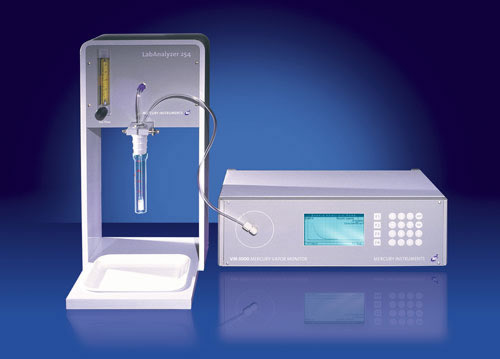
Typical Applications for LA-254 Mercury Analyzer
- Water samples: drinking water, waste water, ground water, surface water, sea water
- Soil and sludge samples
- Geological sample material
- Waste samples: glass, construction rumble, contaminated liquids, wood
- Incineration plant monitoring: smoke gas scrubber water, smoke gas analysis
- Monitoring of foods
- Clinical samples: urine, saliva
- Chemical industry: environmental protection and quality control
- Petrochemical industry
- Research
Measuring Principle - cold vapor atomic absorption spectroscopy
(CVAAS)
First the mercury contained in the sample is stripped with an air stream and sucked into an optical cell made of fused silica. There the quantitative determination of mercury is obtained by measuring UV absorption at a wavelength of 254 nm. This method is commonly known as the "cold vapor atomic absorption spectroscopy (CVAAS)" method.
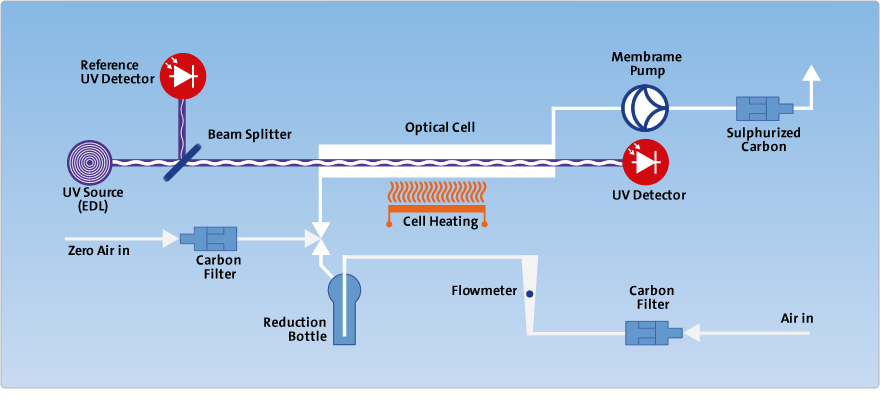
Operation and maintenance
The LabAnalyzers 254 is operated with a waterproof membrane keypad and a graphic LCD. Handling is extremely easy. The LabAnalyzer 254 does not require auxiliary gases. The carrier gas flow required for the analysis is generated by a built-in membrane pump which is maintenance-free and has a long service life.
Using the LabAnalyzer-254 is easy:
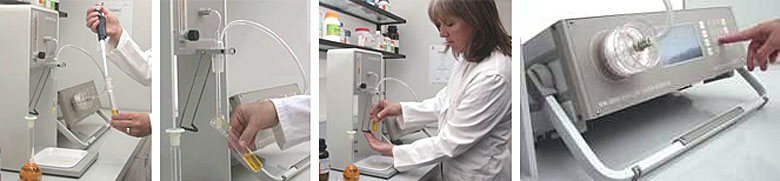
| (1) Fill sample into reaction flask and add 0.5 ml of reagent |
(2) Attach reaction flask to reaction unit bubbler tube |
3) Close securing bracket of reaction unit |
(4) Start measuring by a keypress |
Safety for the user
The mercury cannot escape into the working environment, as any free mercury is collected in a sulfurized activated carbon absorber. If the cartridge needs replacement a message appears on the control panel. The analyzed sample no longer contains any mercury
Fast measurement
Even with high concentrations, no lengthy purging time is required. The typical duration of a measurement including purging is 60 to 100 sec. over the entire measuring range.
During the entire measurement the measuring signal is continuously displayed on the graphic display. An acoustic alarm is sounded to indicate the end of the measurement. In addition to the measurement signal curve over time, the peak value and the mercury concentration are indicated.
Together with the data necessary for quality assurance the results of the analyses are stored in the RAM of the built-in computer. They are available at any time, and an automatic print-out of this data is also possible.
| Measuring principle | UV-Absorption |
|---|---|
| Wavelength | 254 nm |
| UV source | electrodeless low-pressure mercury lamp (EDL), temperature-controlled |
| UV detectors | Silicon, UV-enhanced, temperature controlled |
| Stabilization method | Double beam (reference beam) method |
| Optical cell | Fused silica (Suprasil), approx. 23 cm long |
| Optical cell heating | approx. 70°C |
| Measuring range | lowest range: 0...1 µg/Lhighest range: 0...100 mg/l |
| Pump | long-life membrane pump |
| Air stream | 30 l/h, adjustable |
| Measuring range | 0.01 µg/l ... 10 µg/l (10 ppt ... 10 ppb) for 10 ml |
| Sensitivity | 5 ng/l or 0.05 ng |
| Sample volume | 2 ... 10 ml |
| Reducing agent | tin-II-chloride or sodiumborohydride |
| Display of readings | Graphic LCD with background illumination |
| Outputs | analogue 4-20 mA, USB / RS 232 computer output, parallel Centronics printer output |
| Power Supply | 230 VAC/ 50-60 Hz (optional 115 VAC / 50-60Hz) |
| Power consumption | 35 W |
| Dimensions | 45 x 15 x 35 cm (Wx H x D) photometer section24 x 48 x 27 cm (Wx H x D) reaction bottle section |
| Required floor space | approx. 70 x 50 cm (W x D) |
| Weight | approx. 10 kg |
| ISO 9001 | As a leading supplier of high precision analytical equipment, we strive at all times to offer top quality solutions. Our products are manufactured according to the ISO 9001 quality regulations. |
Downloads
Download our digital brochure to learn more about about product details, safety information and other special features and benefits.
Download PDF BrochurePurchasing Information
Interested in purchasing or renting one of our products? Get started by requesting a quote. A member of our team will contact you directly with more information and next steps.
Request a Quote